Is home row typing really the fastest way to type?
Touch typists are faster on average, but by less than most courses suggest. Here is what studies of 30, 48 and 168,000 typists measured, and when learning the home row is worth the effort.
- Published: 20 October 2026
- Editorial guide
- By Editorial Desk
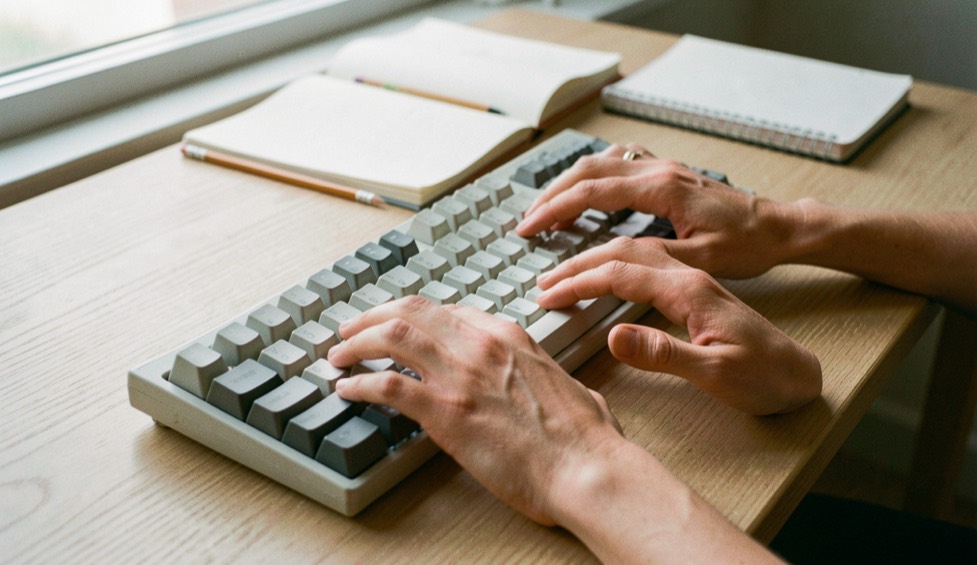
Home row touch typing is not the only way to type fast, but it is the most dependable route to high speed. In a Vanderbilt University study of 48 typists, people who used the standard finger map averaged about 80 words per minute against about 66 for self-taught typists, and they were more accurate. Researchers at Aalto University found that self-taught typists using about six fingers could match course-trained typists on everyday sentences, and that consistent habits predicted speed better than the number of fingers. The advantage of the home row is real, but it is smaller than most courses imply, and much of it comes down to where your eyes go.
What does home row typing mean in these studies?
On a QWERTY keyboard the home keys are A, S, D and F for the left hand and J, K, L and the semicolon for the right. Touch typing gives every other key to one finger, which reaches out and comes back to that resting position without looking. Most keyboards mark F and J with a small raised bar or dot so that the index fingers can find their place by feel. If you want the mechanics of that resting position in detail, our guide on how the home row works as a reset point takes it step by step.
Researchers usually compare this standard finger map with everything else: two-finger hunt and peck, hybrid styles that use some but not all of the fingers, and personal systems in which one hand travels across half the keyboard. The useful question is less how many fingers you use than whether each finger has a fixed job.
What did researchers find when they compared touch typists and self-taught typists?
In 2016 a team at Aalto University in Finland, Anna Feit, Daryl Weir and Antti Oulasvirta, recorded 30 people transcribing ordinary sentences with an optical motion capture system of 12 high-speed infrared cameras, so they could see exactly which finger pressed which key. Self-taught typists used about six fingers on average, yet as a group they reached a similar average speed and accuracy to people who had taken a typing course. They did spend roughly twice as much time looking at their fingers instead of the screen. The project is described on Aalto's How We Type research page.
The same year, Gordon Logan and colleagues at Vanderbilt University tested 24 standard and 24 nonstandard typists while changing what they could see: a normal keyboard, keycaps covered with blank stickers, and a box hiding both hands and keyboard. Across those conditions the standard typists were faster, at 79.99 against 65.63 words per minute, and more accurate, at around 94 per cent against 83 per cent. The nonstandard group got progressively worse as the keyboard disappeared from view. The Association for Psychological Science published a plain summary of the Vanderbilt typing study.
A much larger online study led from Aalto University and presented at the CHI conference in 2018 gathered 136 million keystrokes from 168,000 volunteers. The average participant typed 52 words per minute and the fastest reached 120. More than 70 per cent had taken a touch typing class, and those who had showed very similar speed, hand use and error patterns to those who had not.
| Study | Who was measured | Main result |
|---|---|---|
| Aalto University, 2016 | 30 people, motion capture while transcribing sentences | Self-taught typists using about six fingers matched course-trained typists on average speed and accuracy |
| Vanderbilt University, 2016 | 24 standard and 24 nonstandard typists, keyboard visible, blanked or covered | 79.99 against 65.63 words per minute, around 94 against 83 per cent accuracy |
| Aalto University, 2018 | 168,000 online volunteers, 136 million keystrokes | Average 52 words per minute, fastest 120; course and no-course groups looked very similar |
Why can a self-taught typist keep up?
The motion capture work points to three habits that predicted speed better than the number of fingers: each letter is always pressed by the same finger, the next keystroke is prepared while the current one is still under way, and the hands as a whole stay still while the fingers move. A typist who has settled into a personal six-finger system can meet all three conditions. A typist who switches fingers for the same letter from one word to the next cannot, however many fingers are involved.
The 2018 data adds a fourth trait, rollover: pressing the next key before releasing the previous one. According to Aalto's report on 136 million keystrokes, fast typists used rollover for 40 to 70 per cent of their keystrokes, whether they touch typed or not. Rollover only works when the next finger already knows where it is going, which is another way of describing a consistent finger map.
Where does the home row still give you an edge?
Three findings favour the standard system. The first concerns your eyes. Self-taught typists in the Aalto study spent about twice as long looking at their fingers, and the Vanderbilt nonstandard group got progressively worse as the keyboard was hidden from view. Looking down costs little when you copy a sentence, and more when you are composing, correcting and rereading what you wrote at the same time.
The second is the ceiling. Aalto's project page describes touch typing as still the best known way to reach very high typing speeds and notes that all world records have been set with it. If your goal is a sustained speed well above 100 words per minute, the standard finger map is the route with the longest track record.
The third is accuracy. The gap of around 94 per cent against 83 per cent in the Vanderbilt test matters as much as the speed gap, because every error has to be noticed and corrected before the text is usable. The 2018 study points the same way: faster typists generally made fewer mistakes, while slower typists made more errors and took longer to find and fix them.
Is it worth switching if you already type quickly with a few fingers?
It depends on where your current method breaks down. Switching has a real cost. Early performance with touch typing is well below that of an established hunt and peck habit, and the Aalto researchers estimate that matching the fast typists in their study takes several hundred hours of deliberate practice. If you already type at a comfortable everyday speed without looking at the keys, a cleaner version of your own system may serve you better than starting again.
Switching makes more sense if you watch the keyboard most of the time, if your errors rise sharply when you compose rather than copy, or if you want speeds that self-taught styles rarely sustain. It also helps to know what the system was built for. Feit has pointed out that touch typing was developed for typing sentences on typewriters, and the Aalto team notes that it is less useful for gaming, programming or media editing, where one hand often stays on the mouse.
How can you test which method works for you?
Measure before you decide. Typing speed is counted in words of five characters, spaces and punctuation included, so a result of 50 words per minute means about 250 characters a minute. Type the same short passage three ways: with the keyboard in view, with your eyes held on the screen, and with a sheet of paper laid over your hands. If your score falls sharply under the paper, your speed depends on sight rather than on finger memory, which is the pattern the Vanderbilt study found among nonstandard typists.
Then check consistency. Type a familiar sentence slowly and notice which finger presses e, n and the space bar each time. If the answer changes, that is the first thing to fix, whichever system you keep. A short daily session such as a ten-minute accuracy drill is enough to settle one finger assignment at a time. The number row is a good place to test the result, because it sits furthest from the resting position, and number-row practice with short groups shows quickly whether each reach comes back to the same place.
Questions readers ask about home row speed
How fast does an average person type?
In the 2018 Aalto study of 168,000 volunteers, the average was 52 words per minute and the fastest participants reached 120. Because a word is counted as five characters, 52 words per minute is roughly 260 characters a minute.
Do you need all ten fingers to type fast?
No. Self-taught typists in the 2016 Aalto study used about six fingers on average and still matched trained typists on average speed and accuracy. What mattered was pressing each letter with the same finger every time, preparing the next keystroke early and keeping the hands still.
Why do the F and J keys have bumps?
They are tactile markers that let the index fingers find the home row without looking. Once the index fingers rest on F and J, the other fingers fall onto A, S and D on the left and K, L and the semicolon on the right, so every reach can start and end in the same place.